# The Brutal Truth About Small Business SEO Automation: What Works (and What's a Waste of Time)
Let's be honest. You're probably drowning. Drowning in emails, drowning in client demands, drowning in the endless quest for more traffic. And somewhere in that maelstrom, the siren song of "SEO automation" whispers sweet promises: *rank higher, effortlessly, while you sleep.*
Sounds amazing, right? A magic bullet for your small business SEO woes. But here's the cold, hard reality: most of what passes for "SEO automation" is either snake oil, a time sink, or a one-way ticket to a Google penalty. I've seen countless small businesses, brilliant at what they do, get completely sidetracked by shiny automation tools that deliver nothing but frustration and empty promises. They spend precious capital on software that claims to "auto-generate backlinks" or "instantly optimize content," only to find themselves back at square one, or worse, with a manual penalty to clean up.
This isn't just about saving time; it's about strategic survival. For a small business, every dollar and every hour counts. You can't afford to chase ghosts. So, let's cut through the noise. We're going to talk about what *actually* works in small business SEO automation, what's pure fantasy, and how you can leverage smart technology to dominate your niche without ever feeling like you're sacrificing quality or authenticity.
### The Automation Delusion: Why Most "SEO Automation" Fails Small Businesses
Before we dive into the good stuff, let's address the elephant in the room. When most people hear "SEO automation," their minds immediately jump to the dark arts: spammy link building, keyword stuffing, or AI-generated content so bland it makes elevator music sound exciting. This perception isn't entirely unfounded; the early days of SEO were rife with black-hat tactics that promised quick wins through automation. And yes, some tools still peddle these dangerous shortcuts.
But that's not what we're talking about here. The real failure point for small businesses isn't the *concept* of automation, but the *misapplication* of it. They often try to automate the wrong things, or they expect a tool to replace strategic thinking and genuine human insight. You can't automate creativity. You can't automate empathy. And you certainly can't automate building real relationships that lead to high-quality backlinks.
What most people get wrong about small business SEO automation is thinking it's a "set it and forget it" solution for their entire SEO strategy. It's not. It's about intelligently offloading repetitive, data-heavy, or technically complex tasks so you can focus your limited time and resources on the high-impact, human-centric activities that truly move the needle. Think of it as a force multiplier, not a replacement for your brain.
### The Foundation: What You Can (and Should) Automate in Small Business SEO
Okay, so if we're not automating spam, what *can* we automate? The answer lies in identifying the repeatable, predictable, and often tedious tasks that consume valuable time but don't require deep strategic thought or creative genius. These are the unsung heroes of efficient SEO.
#### 1. Technical SEO Monitoring & Alerts: Your Digital Watchdog
Technical SEO is the bedrock of your online presence. If your site has crawl errors, broken links, slow page speeds, or indexing issues, all the amazing content in the world won't matter. The good news? Much of this can be automated.
* **Crawl Monitoring:** Tools like Google Search Console (free!) or Screaming Frog (paid, but powerful) can be scheduled to crawl your site regularly. More advanced platforms offer continuous monitoring. They'll flag broken links, redirect chains, duplicate content, and other issues that can hamper your rankings.
* **Page Speed Checks:** Google's PageSpeed Insights API can be integrated into custom scripts or used via third-party tools to monitor your site's performance. You can set up alerts to notify you if certain pages dip below a performance threshold.
* **SSL Certificate Expiration:** Nothing screams "unprofessional" like an expired SSL certificate. Automated tools can track this and send you reminders well in advance.
* **Schema Markup Validation:** As you implement structured data, automated validators can ensure your JSON-LD is correctly formatted and free of errors, helping search engines understand your content better.
The benefit here is immense. Instead of manually checking these things every week (who has the time?), you get proactive alerts. This allows you to fix issues *before* they become major problems, preserving your search visibility and user experience. It's like having a dedicated technical SEO specialist working 24/7, without the salary.
#### 2. Keyword Research & Opportunity Spotting: Finding Gold Without Digging All Day
Keyword research is foundational, but it can be a massive time sink. While the *strategic interpretation* of keywords requires human insight, the *data collection* and *initial filtering* can be significantly automated.
* **Automated Keyword Discovery:** Tools can scrape competitor sites, analyze search queries from Google Search Console, and suggest related keywords based on your existing content. They can identify long-tail opportunities you might never have found manually.
* **Trend Monitoring:** Setting up alerts for trending topics or sudden shifts in search volume around your core keywords can give you a significant competitive edge. Imagine knowing a new product feature is suddenly gaining traction in search *before* your competitors do.
* **Competitor Keyword Gap Analysis:** Automated tools can compare your keyword rankings against competitors and highlight keywords they rank for that you don't. This instantly reveals content opportunities.
This isn't about replacing your brain; it's about feeding it better, faster data. You still need to analyze the intent behind the keywords, assess their difficulty, and decide which ones align with your business goals. But the grunt work of finding them? That's ripe for small business SEO automation.
#### 3. Content Performance Tracking & Reporting: Beyond Just Google Analytics
You're creating content, but is it working? Manually pulling data from Google Analytics, Search Console, and various social platforms is a chore. Automate it.
* **Custom Dashboards:** Build dashboards using tools like Google Looker Studio (formerly Data Studio) that automatically pull in data from all your sources. You can set them up to refresh daily, weekly, or monthly, giving you an always-on view of your performance.
* **Automated Reports:** Schedule reports to be emailed to you or your team on a regular basis. These can highlight key metrics like organic traffic, keyword rankings, conversion rates from organic search, and even content engagement.
* **Content Audit Triggers:** Set up rules to flag content that's underperforming after a certain period (e.g., 6 months with less than 10 organic visits). This helps you identify content that needs updating, optimizing, or even deprecating.
Understanding what's working (and what isn't) is crucial for iterative improvement. Automated reporting frees you from data entry and lets you focus on *acting* on the insights. This is where you identify your content winners and double down, or spot underperformers and strategize a fix.
#### 4. Content Generation (with a HUGE Caveat): The AI Revolution's Role
Now, this is where it gets controversial, and frankly, where most small businesses either get it spectacularly right or horribly wrong. Can you automate content generation? Yes. *Should* you fully automate it? Absolutely not, not if you care about quality, authority, and ranking long-term.
However, AI-powered content generation tools have evolved dramatically. They're no longer just churning out gibberish. When used strategically, they can be a powerful form of small business SEO automation.
* **Drafting & Outlining:** AI is fantastic at generating initial drafts, outlines, and even entire sections of content based on a prompt. This can save hours of staring at a blank page. You provide the strategic direction, the AI handles the first pass.
* **Repurposing Content:** Turn a long-form blog post into social media snippets, email newsletters, or even video scripts with the help of AI. This multiplies the value of your existing content without significant manual effort.
* **Optimizing Existing Content:** AI tools can analyze your content against target keywords, suggesting improvements for readability, SEO, and even identifying gaps in your coverage.
* **Meta Descriptions & Titles:** Generating compelling, keyword-rich meta descriptions and title tags for hundreds of pages can be a tedious task. AI can create variations quickly, which you can then review and refine.
Here's the critical caveat: AI should be your co-pilot, not your pilot. Every piece of AI-generated content *must* be reviewed, edited, fact-checked, and injected with your unique brand voice and human insight. Think of it as a hyper-efficient research assistant and first-draft writer. Without human oversight, you risk bland, generic content that Google's helpful content systems will likely deprioritize. For a deeper dive into this, you might want to check out our guide on [AI SEO content generation](https://contentzero.life/ai-seo-content-generation).
#### 5. Local SEO Management: Dominating Your Neighborhood
For brick-and-mortar small businesses, local SEO is paramount. And much of it is highly automatable.
* **Google Business Profile (GBP) Management:** While you can't fully automate responding to reviews (and shouldn't!), you can automate updates to your business hours, special offers, and even post new content to your GBP profile. Tools exist that can push updates across multiple listings if you have several locations.
* **Review Monitoring & Aggregation:** Automated tools can monitor new reviews across platforms (Google, Yelp, Facebook, industry-specific sites) and consolidate them into a single dashboard. This allows for quicker responses and sentiment analysis.
* **Citation Building & Auditing:** Ensuring your Name, Address, Phone (NAP) is consistent across directories is crucial. Automated tools can scan for inconsistencies and help you build new citations efficiently.
Local SEO automation ensures your business information is accurate and consistent everywhere your potential customers are looking. This builds trust and helps you rank in the "map pack" results.
### What NOT to Automate (Unless You Want a Google Penalty)
Just as important as knowing what to automate is knowing what *not* to touch with an automation stick. These are the areas where human judgment, creativity, and genuine relationship-building are irreplaceable.
* **Link Building (The Spammy Kind):** Any tool promising "automated backlinks" is a red flag. Real, high-quality backlinks come from earning them through great content, outreach, and genuine relationships. Automating this process almost always leads to low-quality, irrelevant links that can hurt your rankings.
* **Strategic Planning & Goal Setting:** Your SEO strategy should be driven by your business goals, market analysis, and competitive landscape. No tool can understand your unique value proposition or your long-term vision.
* **Customer Interaction & Personalization:** While chatbots can handle basic queries, true customer engagement, personalized content experiences, and responding to complex customer needs require a human touch.
* **Creative Content Ideation (Purely):** While AI can assist, the spark of a truly original idea, a unique angle, or a compelling story that resonates deeply with your audience still comes from human creativity.
* **In-Depth Content Editing & Fact-Checking:** As mentioned, AI drafts need human polish. Fact-checking, ensuring accuracy, and adding nuanced insights are non-negotiable.
### Building Your Automated SEO Workflow: A Practical Roadmap
So, you're convinced that smart small business SEO automation is the way to go. How do you actually implement it without getting overwhelmed?
1. **Audit Your Current SEO Tasks:** Make a list of everything you (or your team) do for SEO in a typical week or month. Be brutally honest about how much time each task consumes.
2. **Identify Automation Opportunities:** Go through your list and mark tasks that are repetitive, data-heavy, or technically focused. These are your prime candidates for automation.
3. **Start Small, Iterate Often:** Don't try to automate everything at once. Pick one or two high-impact, low-complexity tasks first. Maybe it's setting up a Google Search Console dashboard or automating your page speed checks.
4. **Choose the Right Tools:** Research tools carefully. Look for solutions that integrate well with your existing tech stack and offer good support. Don't overspend on enterprise-level tools if a simpler, more affordable option will do. For content automation specifically, you'll want to explore platforms that focus on [automated blogging](https://contentzero.life/automated-blogging) and content creation.
5. **Define Human Touchpoints:** For every automated process, clearly define where human oversight, review, and strategic input are required. This is crucial for maintaining quality and avoiding pitfalls.
6. **Measure and Refine:** Automation isn't a one-and-done deal. Continuously monitor the performance of your automated workflows. Are they saving you time? Are they delivering better results? Adjust as needed.
Remember, the goal isn't to eliminate humans from the SEO equation. It's to empower them. By offloading the mundane, you free up your team to focus on the strategic, creative, and relationship-building aspects of SEO that truly differentiate your small business.
### The Future is Automated, But Human-Led
The landscape of search is constantly evolving. With the rise of conversational AI and large language models like ChatGPT, Perplexity, and Claude, the way people find information is shifting. This means your content needs to be not just optimized for traditional search engines, but also highly informative, authoritative, and truly helpful to answer complex queries. This is where smart small business SEO automation becomes even more critical.
By automating the foundational and repetitive tasks, you gain the bandwidth to create the kind of deep, insightful, and unique content that stands out in an increasingly crowded digital world. You can spend more time understanding your audience, crafting compelling narratives, and building genuine connections – things no algorithm can ever truly replicate.
Don't let the fear of "black hat" tactics or the overwhelm of new technology stop you. Embrace the power of intelligent automation to streamline your SEO, boost your rankings, and ultimately, grow your small business. It's not about working less; it's about working smarter, and focusing your precious human energy where it matters most.
Ready to transform your content strategy and leverage the power of AI-driven SEO without the heavy lifting? Explore how [ContentZero.life](https://contentzero.life) can help you generate high-ranking content and dominate search, completely hands-free.
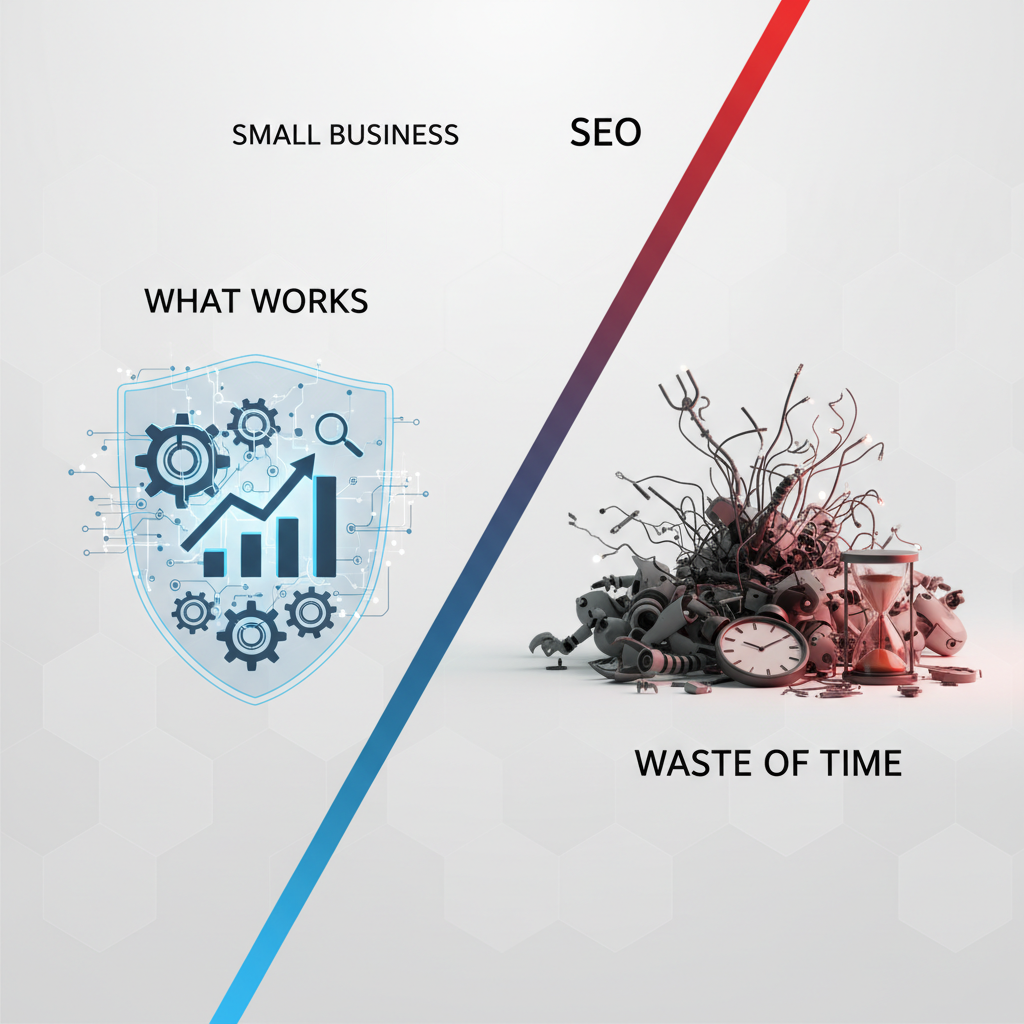
AI-Generatedsmall business SEO automation
The Brutal Truth About Small Business SEO Automation: What Works (and What's a Waste of Time)
Stop wasting time on manual SEO. Discover how small business SEO automation can catapult your rankings and free up your schedule, without sacrificing quality.
C
ContentZero AIMore from ContentZero

The Complete Guide to SaaS SEO content strategy AI
Unlock the future of SaaS SEO. We'll expose why most AI content strategies are doomed and reveal the truly disruptive path to Google and AI visibility.

Beyond Google: How to Optimize Your Content for LLM Visibility (A Step-by-Step Guide)
Master LLM visibility optimization. Learn how to get your content cited by ChatGPT, Perplexity, and Claude, ensuring your brand dominates AI search.

The AI Content Revolution: How to Actually Win Google and AI Search (Without Writing a Single Word)
Stop wasting time on AI content that doesn't rank. This guide cuts through the hype, showing founders and marketers how to truly leverage AI for digital marketing content that dominates Google and AI search.